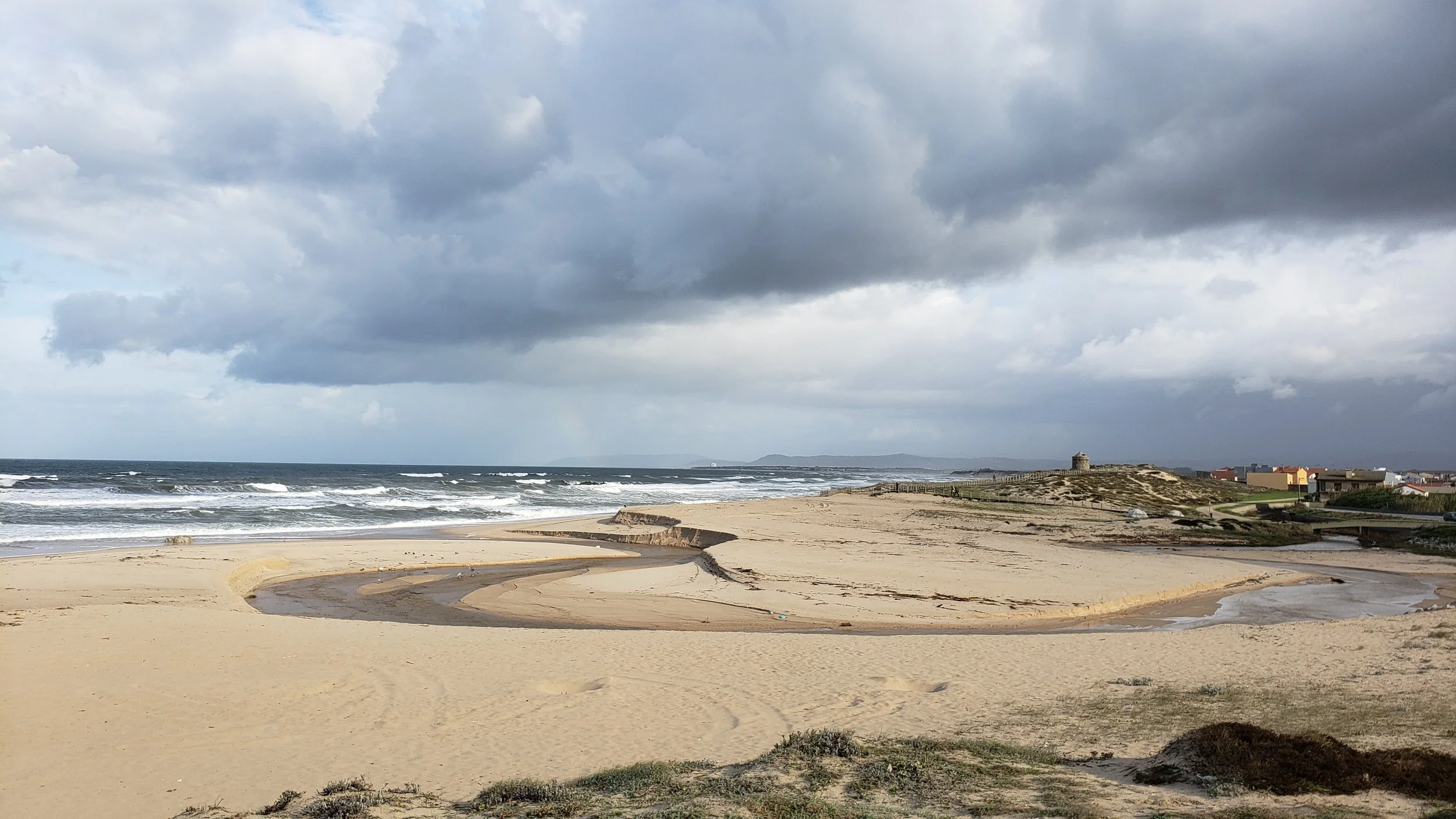
The Coastal Way
Camino Portugués Coastal — Porto to Santiago de Compostela
The most visually beautiful of the main Camino routes. 280 kms in 10 to 11 days.
North from Porto
The Coastal Camino follows the Atlantic shoreline north from Porto through the fishing villages, dramatic beaches, and rocky headlands of northern Portugal before crossing into Galicia and arriving in Santiago de Compostela. Less crowded than the Francés, more consistently beautiful, and one of the most rewarding walks in Europe.
A word on the weather: the Coastal Camino passes through one of the wettest regions in Europe. The Atlantic delivers rain without warning and without apology. Good waterproofs are not optional on this route — they are essential regardless of season.
What this route gives you
The Coastal Camino gives you beauty, consistently and without restraint. The Atlantic is beside you for much of the route — visible, audible, and present in a way that changes how the walking feels. The light on the Portuguese coast in the late afternoon is something specific and unrepeatable. The fishing villages, the headlands, the long beaches with nobody on them — this is walking at its most visually rewarding.
It is also the most varied of the routes we offer. Northern Portugal is its own world — different architecture, different food, different pace, the Portuguese language giving everything a slightly different texture from the moment you leave Porto. The crossing into Galicia brings another shift. By the time you arrive in Santiago you have walked through three distinct cultural landscapes and two countries.
The route is less crowded than the Francés in most seasons and considerably more beautiful in most stretches. The weather is honest — the Atlantic coast is wet, sometimes dramatically so, and good waterproofs are not optional. But the same weather that delivers rain also delivers the low cloud, the silver light, and the particular atmosphere that makes this coastline one of the most beautiful in Europe to walk through.
Stages of the Coastal Route
Section 1 — Porto to A Guarda~120km · 4 to 5 days
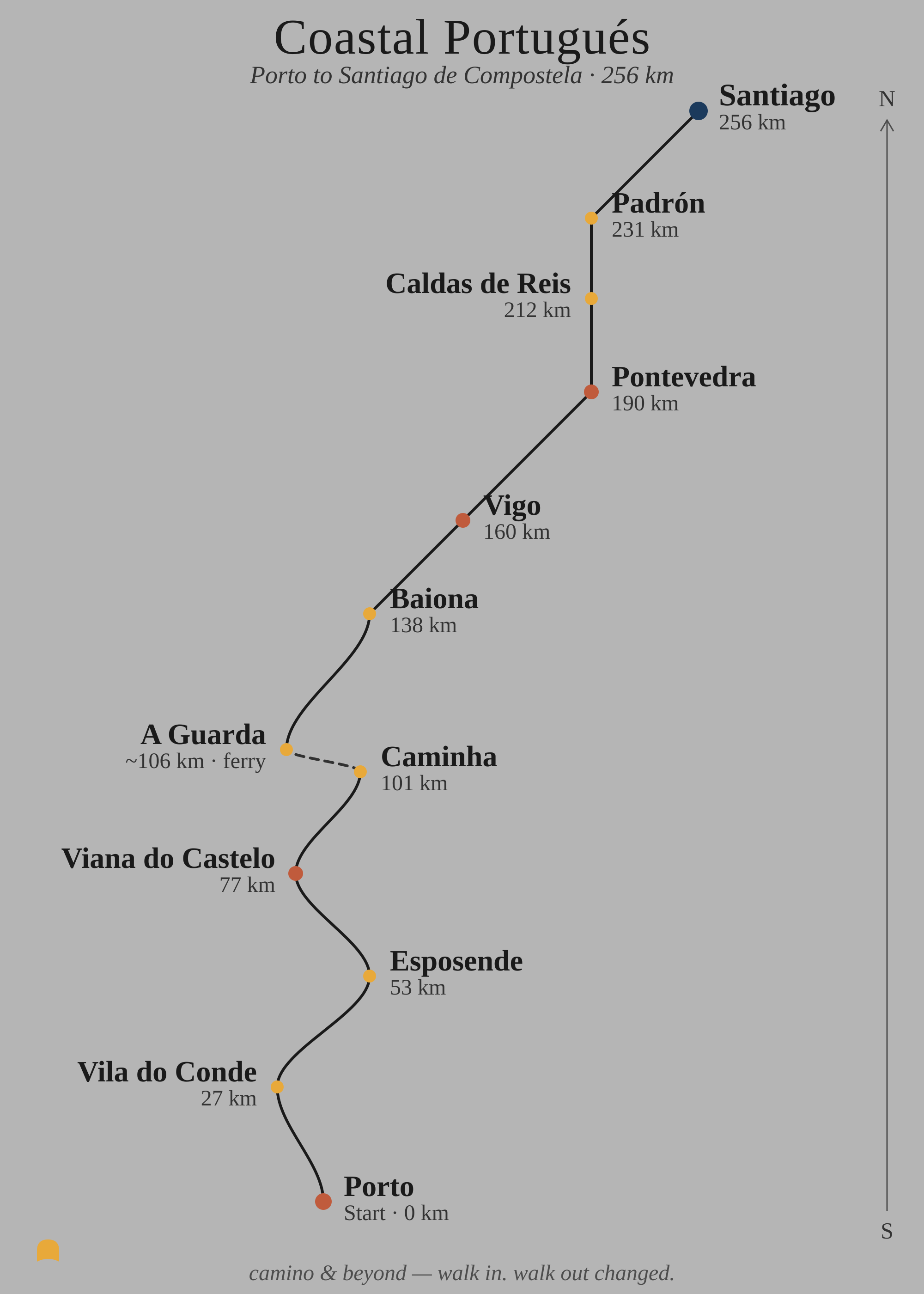
The Portuguese section. The route follows the Atlantic coast north from Porto through the fishing villages and beaches of northern Portugal — Vila do Conde, Esposende, Viana do Castelo — before arriving at Caminha on the Portuguese bank of the Minho river.
The border crossing is made by small ferry across the Minho estuary from Caminha to A Guarda on the Spanish side — one of the great moments on the route. A short 15 minute crossing that moves you from Portugal into Galicia, from one culture to another. The ferry runs on tidal conditions and does not operate on all days or at all times — check schedules in advance and allow flexibility in your day. From the Spanish landing at Camposancos, A Guarda centre is 3km direct or 6.8km via the scenic coastal sea path. We recommend the coastal path if your legs allow it. A taxi across is a reliable alternative if the ferry is not running.
A Guarda is a working fishing town with a good old quarter and the remarkable Monte de Santa Trega above it — a Celtic hill fort with extraordinary views across the estuary and the Atlantic. Worth the climb if your legs have anything left.
Stages: Porto → Vila do Conde (27km) → Esposende (26km) → Viana do Castelo (24km) → Caminha (24km) → A Guarda via ferry (3 to 7km on the Spanish side depending on route taken)
Note: Póvoa de Varzim between Vila do Conde and Esposende is an optional overnight stop for those who prefer shorter first stages.
Section 2 — A Guarda to Santiago de Compostela~160km · 6 to 7 days
The Spanish section. The route follows the Galician coast north from A Guarda through the ría country — the deep Atlantic inlets that define this coastline — before turning inland through Pontevedra and Padrón toward Santiago.
Baiona is the highlight of this section and one of the great stops on any Camino route. A medieval town on a peninsula jutting into the Atlantic, it was the first port in Europe to receive news of Columbus's discovery of the New World in 1493. The Parador de Baiona occupies the medieval castle on the peninsula — personally verified, November 2019, and one of the great accommodation experiences on any Camino. We recommend it without reservation.
Pontevedra deserves more time than most pilgrims give it — one of the best preserved medieval old towns in Galicia, car-free in its historic centre, with the Parador at its heart.
Stages: A Guarda → Baiona (32km) → Vigo (22km) → Pontevedra (~30km) → Caldas de Reis (22km) → Padrón (19km) → Santiago de Compostela (25km)
Note: The A Guarda to Baiona stage at 32km is the longest on this section — start early. The Vigo to Pontevedra stage passes through Redondela roughly halfway — consider stopping there if the day is feeling long.
More time? See the Camino Frances. And Via de la Plata