Camino Finisterre & Muxía — The Way to the End of the World
Santiago de Compostela to Finisterre and Muxía
Five to seven days beyond Santiago, and the natural conclusion to any Camino — particularly the Francés.
Beyond Santiago
Most pilgrims arrive in Santiago and stop. The cathedral, the square, the embrace of the statue — and then a flight home. But the Camino Francés was always meant to continue. Medieval pilgrims didn’t turn around at the cathedral. They kept walking west, toward the coast, toward the place they believed was the edge of the known world. Cape Finisterre — finis terrae, the end of the earth — was the original destination. Santiago came later.
Walking beyond Santiago is not an extension of the Camino. It is the completion of it.
What this route gives you
The Camino to Finisterre gives you something the main route cannot — the experience of walking away from the place you walked toward for weeks or months, into something quieter and less certain. The crowds thin immediately after Santiago. Within a few hours you are back on a trail that feels like the Camino at its best: unhurried, wild in stretches, the Atlantic growing closer with every stage.
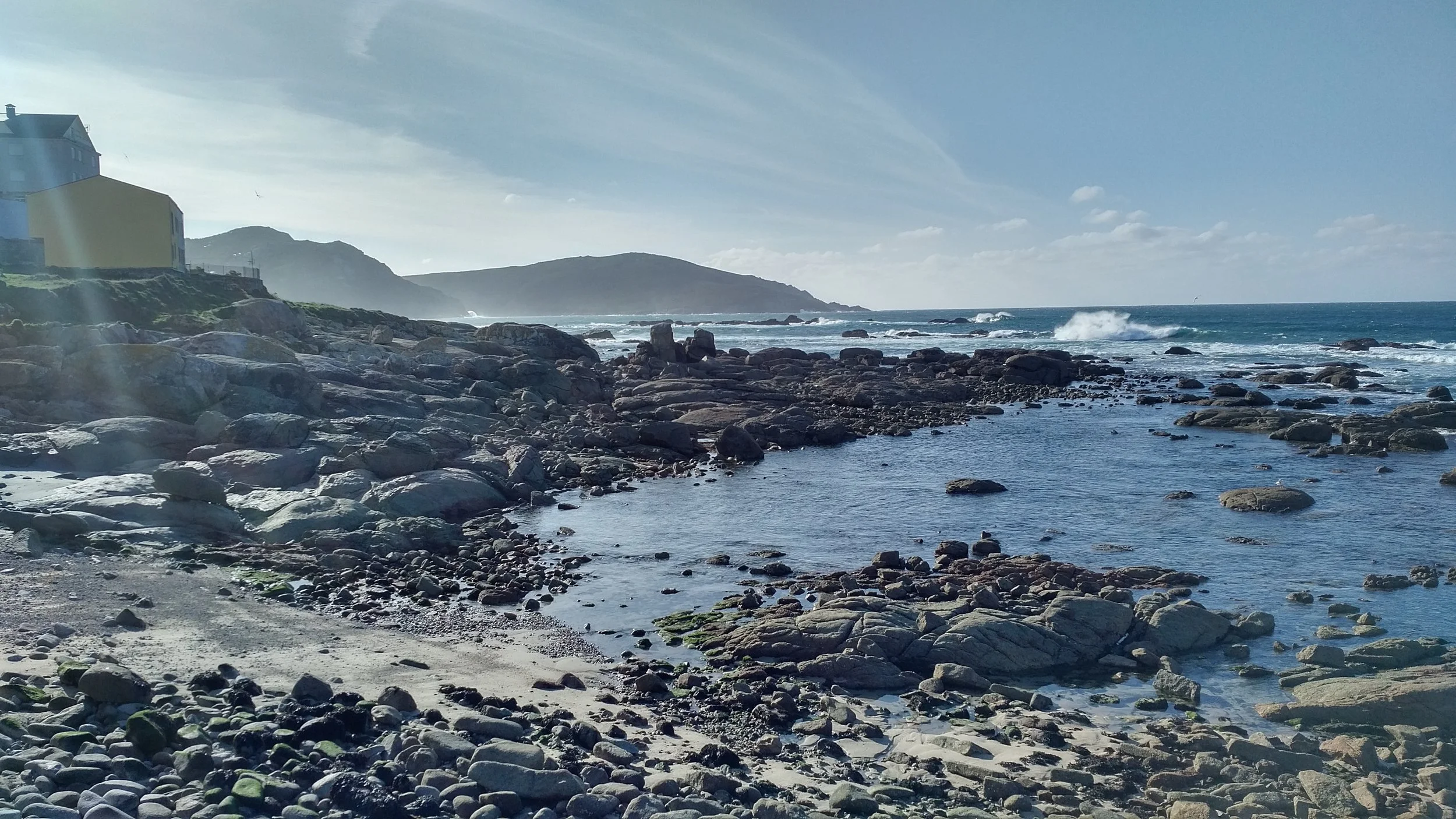
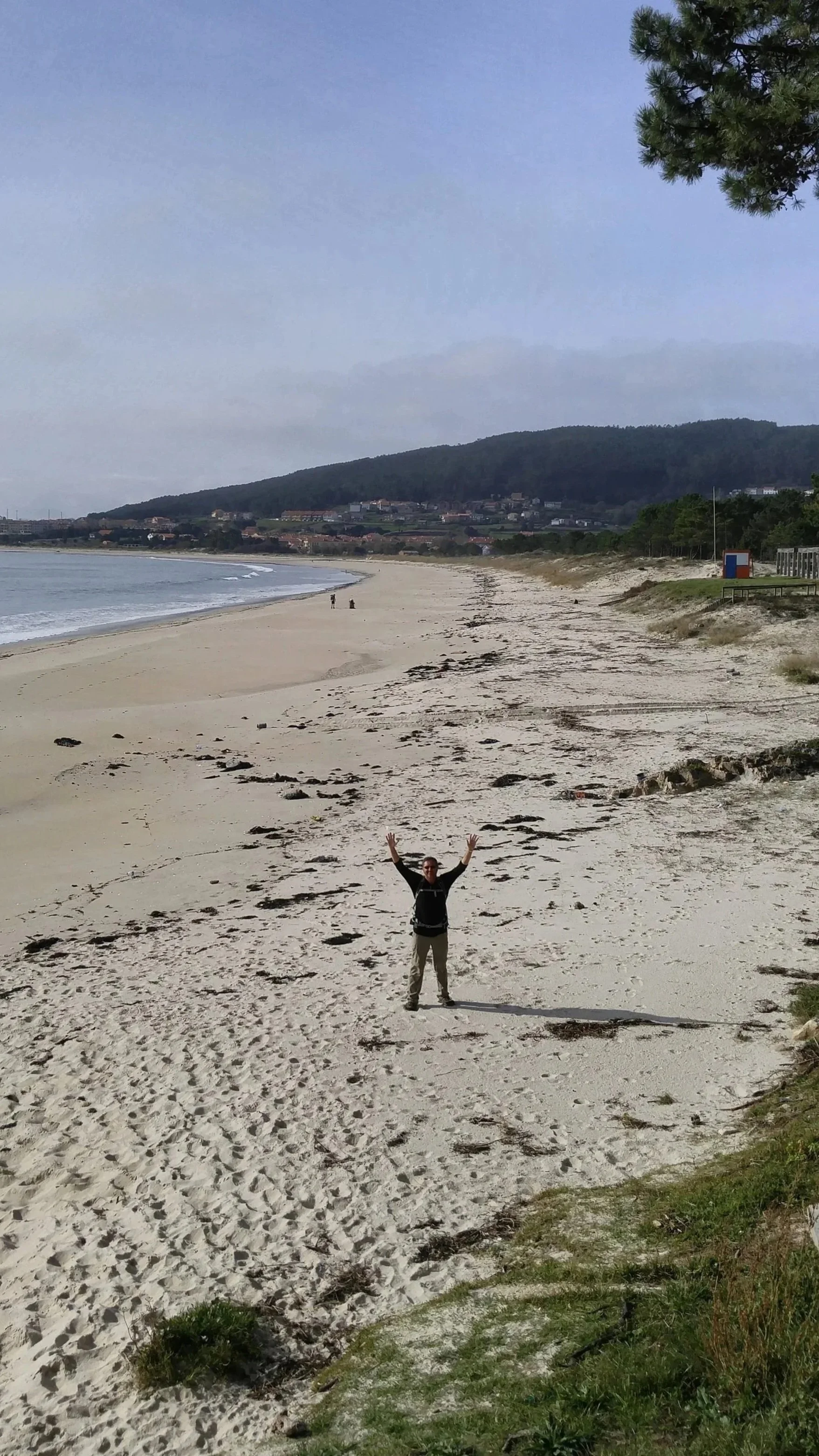
The coastline that begins at Cee and follows you into Finisterre is some of the most dramatic walking in Galicia — the smell of the ocean before you see it, the light changing as the land narrows toward the cape, and then Praia de Langosteira opening ahead of you, two kilometres of beach with the town at the far end and a bar at the edge of it. That arrival — sand underfoot, the Atlantic beside you — is one of the finest on any Camino route.
Muxía gives you something else entirely. Smaller, older, less visited, its rocky sanctuary on the headland carries a weight that has nothing to do with medieval pilgrimage and everything to do with something older. Stand on the Pedra de Abalar and look west. There is nothing between you and North America.
Five to seven days. The end of the road, in every sense.
Stages of the Camino Finisterre & Muxia
Stage 1 — Santiago de Compostela to Negreira (~21km)
The route leaves from the Cathedral — a strange feeling, walking away from the place you walked toward for so long. The first kilometres pass through Santiago’s quieter neighbourhoods before opening into Galician countryside. Oak and eucalyptus forest, small villages, the long descent to the Roman bridge at Ponte Maceira — one of the most photographed spots on this route. The stage ends in the market town of Negreira.
Stage 2 — Negreira to Olveiroa (~25km)
The longest stage on the route and the most physically demanding. Through thick oak groves, granite villages, and the wide Galician landscape that feels entirely removed from the meseta.
Stage 3 — Olveiroa to Cee (~24km)
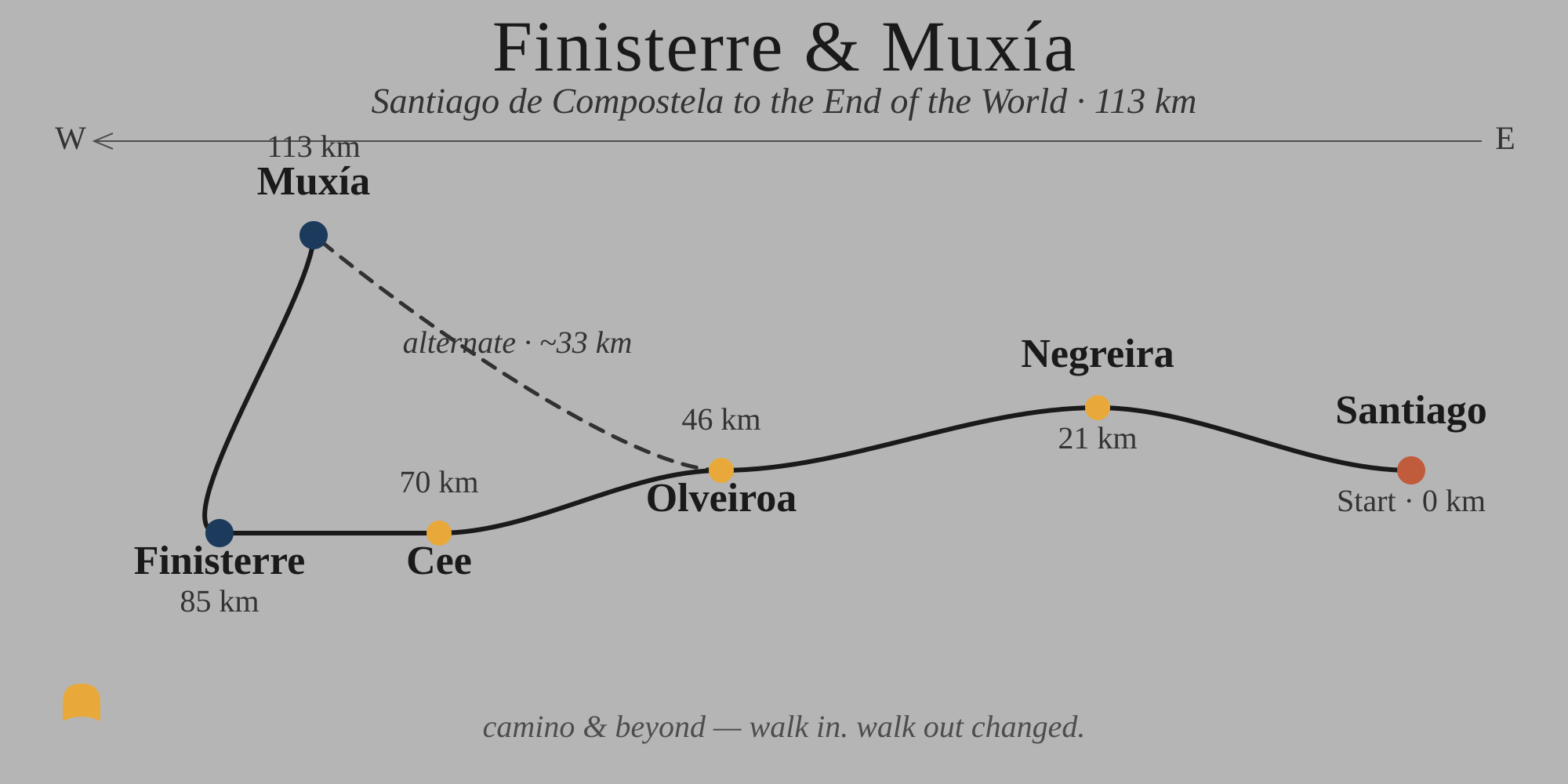
The path continues from Olveiroa and then reaches the critical fork: six kilometres in, just past the village of Hospital, a stone landmark marks the split. Left goes to Finisterre. Right goes directly to Muxía. Continue left. The landscape shifts as you descend toward the coast — the first smell of the Atlantic, the light changing, the sense that something is ending. The stage finishes in Cee, a working coastal town on the Ría de Cee.
Stage 4 — Cee to Cape Finisterre (~15km)
The path follows the coast from Cee through Corcubión before the final approach to Finisterre. The last couple of kilometres into town follow Praia de Langosteira — the Atlantic on your left, the sand under your feet, the town ahead. It is one of the finest arrivals on any Camino route. At the end of the beach, at the edge of town, there is a bar. Stop. Sit down. Order a caña. You have earned it.
The lighthouse at Cabo Finisterre is a further one to two kilometres beyond the town, up the headland. The 0.00km marker stands at its base. The Atlantic stretches west with nothing between you and North America. Most pilgrims walk up to the lighthouse in the afternoon after arriving in town, or first thing the following morning before leaving for Muxía. Either works. The sunset from the headland, if the weather allows, is extraordinary.
Some pilgrims burn their boots or a piece of clothing at the lighthouse — an old tradition, now discouraged but still practised. Stay the night in Finisterre town.
Stage 5 — Finisterre to Muxía (~28km)
The longest coastal stage. The path leaves Finisterre and follows a route of headlands, fishing villages, and Atlantic views. The day ends in Muxía — a small town of around 3,000 people built around its harbour and the sanctuary of Nosa Señora da Barca on the rocks at the point. Walk out to the sanctuary. Stand on the Pedra de Abalar. The Camino ends here.
Stage distances at a glance
Santiago → Negreira: ~21km → Olveiroa: ~25km → Cee: ~24 → Finisterre: ~15km → Muxía: ~28km Total: ~117km / 5 walking days
A note on Muxía
Muxía is not Santiago and it is not Finisterre. It is something else — quieter, older, less visited. The sanctuary of Nosa Señora da Barca sits on a rocky promontory at the edge of the Atlantic, surrounded by the flat stones the Celtic tradition considered sacred long before the Camino existed. Walk out to the rocks in the morning before you leave.
A word of advice: if you arrive on a Saturday evening, accept whatever invitation presents itself. The town is small but it knows how to finish a week.
The route in reverse — Muxía first
Walking Santiago to Muxía directly is possible and some pilgrims prefer it — the route splits at Olveiroa and the Muxía branch continues directly northwest without the coastal descent to Cee. The final stage from Muxía to Finisterre is approximately 28km. The emotional logic is reversed — you end at the lighthouse rather than the sanctuary. For some pilgrims that is the right shape. For most, we recommend Finisterre first.
You can walk this route in either direction. Most pilgrims walk to Finisterre first and Muxía second and we recommend this sequence for a reason: the two endings are different in character and the order matters.
Finisterre is the dramatic finish — the lighthouse at the edge of the Atlantic, the 0.00km marker, the sunset over open ocean. It is the physical conclusion of the walk, the moment the road literally runs out. Walk here first.
Muxía is quieter and more contemplative — a small fishing village built around an ancient stone sanctuary on a rocky headland, with a spiritual and pre-Christian history that long predates the Camino itself. The Pedra de Abalar, the rocking stone at the sanctuary of Nosa Señora da Barca, has drawn pilgrims for centuries. Walking here second, after Finisterre, gives the route its proper arc — achievement first, reflection after
Walk the Camino Frances or Coastal Route first