Joost & the Filmmakers liked it. The Dane didn’t.
In Emilio Estevez's 2010 film The Way, Martin Sheen plays an American father who walks the Camino Francés to honour his son. Along the route he picks up a handful of fellow pilgrims — one of whom, the jovial Dutch walker Joost, cheerfully identifies himself as a credit card pilgrim. Good hotels. Luggage transfer. No apologies.
We love that film. We rewatch it before every Camino we walk. It captures something true about what this road does to people and the accidental community that forms along it. Watch it before you go. Watch it again the night before you leave.
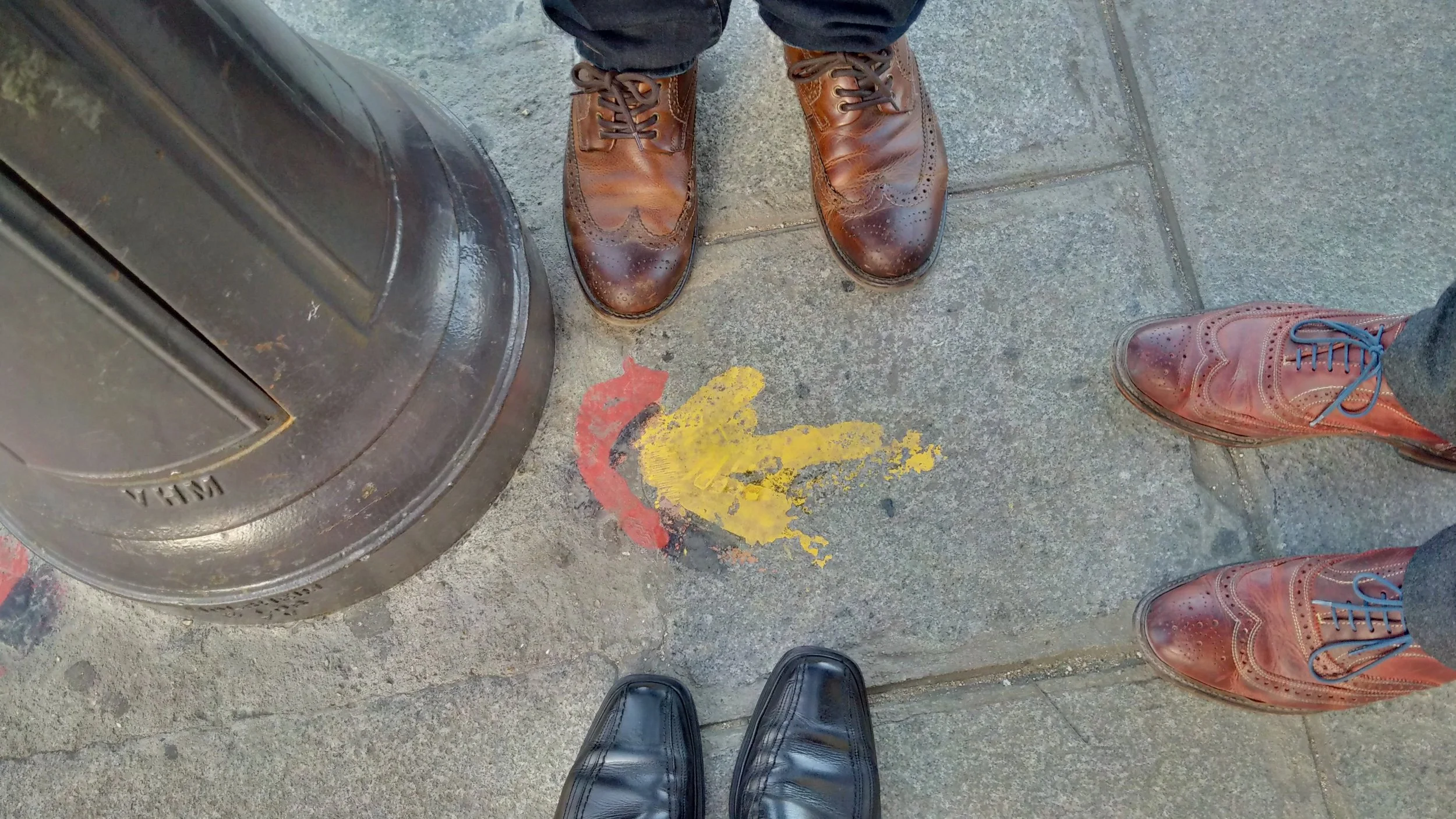
A Camino arrow in front of Notre Dame in Paris - on the Chemin St.Jacques.
We came to the Camino having seen the film, already half-identifying with Joost. Then in 2012, two filmmakers from Nevada pulled us off the trail to interview us for their own documentary. They took one look at us — three Canadians with day packs, luggage mysteriously appearing at every hotel, eating well every evening — and called us, accurately, the self-proclaimed credit card peregrinos.
We didn't invent the term. Joost did. We just lived it for five years and built a company around it.
"The walk is the Camino. Where you sleep is logistics. Joost understood this. So do we."
What the Credit Card Pilgrim experience actually is
The Credit Card Pilgrim is not a lesser version of the traditional experience. It is a different entry point to the same journey. You still walk every kilometre. You still cross the Pyrenees. You still arrive in Santiago having carried your own weight across the north of Spain. You just do it without a 12-kilogram pack and a top bunk in a dormitory of forty snoring strangers. For some people — those at a certain point in life, those with a body that has earned its opinions, those who want the transformation without undue punishment — this is the right way. That is who we built Camino & Beyond for.
In November 2012, walking out of a burnt, dusty valley on a narrow, winding trail between Los Arcos and Logroño, we came up behind a thirty-something Danish pilgrim carrying a large, full pack. He refused to let us pass. He eventually turned and told us, with some heat, that without carrying a full pack we were not real pilgrims. And questioned, in very descriptive language, why we were walking at all. It stopped us in our tracks. We had walked every kilometre from Saint-Jean-Pied-de-Port. We had crossed the Pyrenees, slept in the same towns, eaten the same pilgrim menus, stamped our credentials at the same places as every other pilgrim on the road. When we were finally able to move past him, Paul said to the Dane: "We are walking every step. That is what the Camino is about." Paul is right. That sentence is the whole answer. We tell this story not to dismiss the traditional pilgrim — the one with the full pack, sleeping in the albergue bunk — but because it clarifies what we believe to be true.
The traditional Camino is valid and real and we support it completely. We are here to bring more people to the road — people who assumed the Camino was not for them because they imagined it required suffering as a prerequisite. It does not. The Walk is the point. Where you sleep and how your pack travels are logistics.
However you choose to pack your bag, the road is yours. Lets Talk.