Un Sello, Por Favor.
What they are, what they mean, and why they end up meaning more than you expect.
Un sello, por favor — a stamp, please — is one of the most useful phrases you'll learn on the Camino. You'll say it at albergues, churches, cafés, and bars, dozens of times over the course of a walk, and each time someone reaches for an ink pad and presses their mark into your credencial.
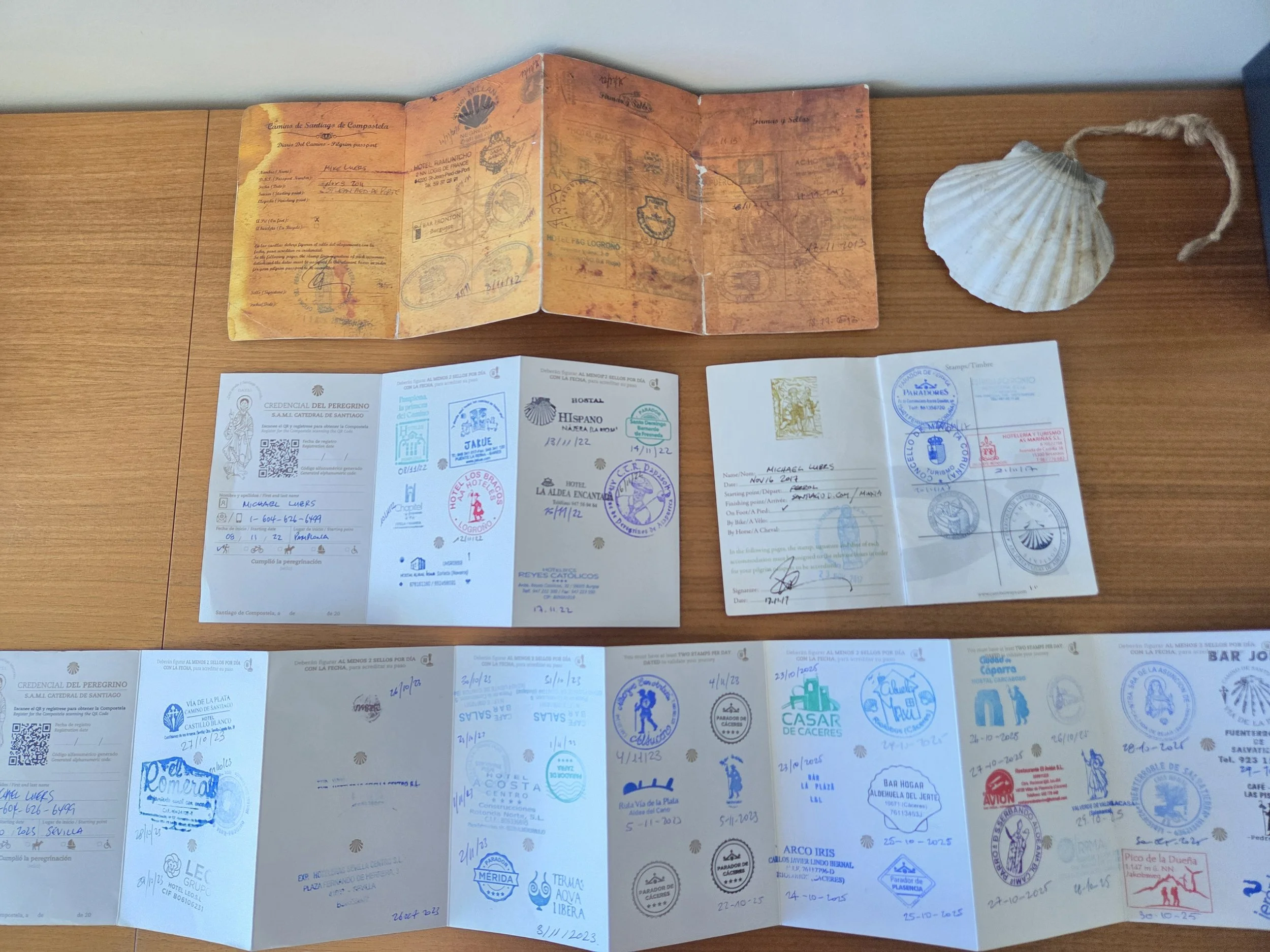
The credencial — your pilgrim passport
The credencial is a small folding document, a little larger than a passport page, with blank boxes waiting to be filled. You carry it every day, and as you collect each sello the document slowly fills with the places you actually stopped.
You will need at least one stamp a day for most of the route, and two a day for the final 100km into Santiago. Most pilgrims collect far more than the minimum without trying — a morning coffee, a lunch stop, the albergue at the end of the day, all of them happy to stamp your credencial as you go.
Our own Francés credencial — the one from our very first Camino in 2011 — is so densely stamped it is hard to find a clear patch of paper anywhere on it. We collected a sello or two every day across five separate trips over five years, and the document was simply never designed to hold that much. It is layered, overlapping, occasionally illegible in places — and we would not trade it for a clean one.
A confession about ours
That same 2011 credencial has another story attached to it. The tour operator we booked through at the time sent it to us already aged — deliberately darkened paper, made to look centuries old before we had stamped a single box. It looked wonderful in the photos. It was considerably less wonderful at the Pilgrim's Office in Santiago, where the staff politely pointed out that the artificial ageing made our actual stamps harder to read. We don't believe any operator does this anymore. But we still have the credencial, slightly absurd and entirely real, and it remains our favourite of the four.
Where to get one
You do not need a tour company to get a credencial, and you should not pay much for one. The official document, authorised by the Cathedral of Santiago, typically costs two to five euros and is available before you leave from pilgrim associations and confraternities in North America, or once you arrive in Spain from albergues, parish churches, and pilgrim offices along the route. If you start walking without one, almost any albergue on the first day can set you up.
The Compostela — what it actually certifies
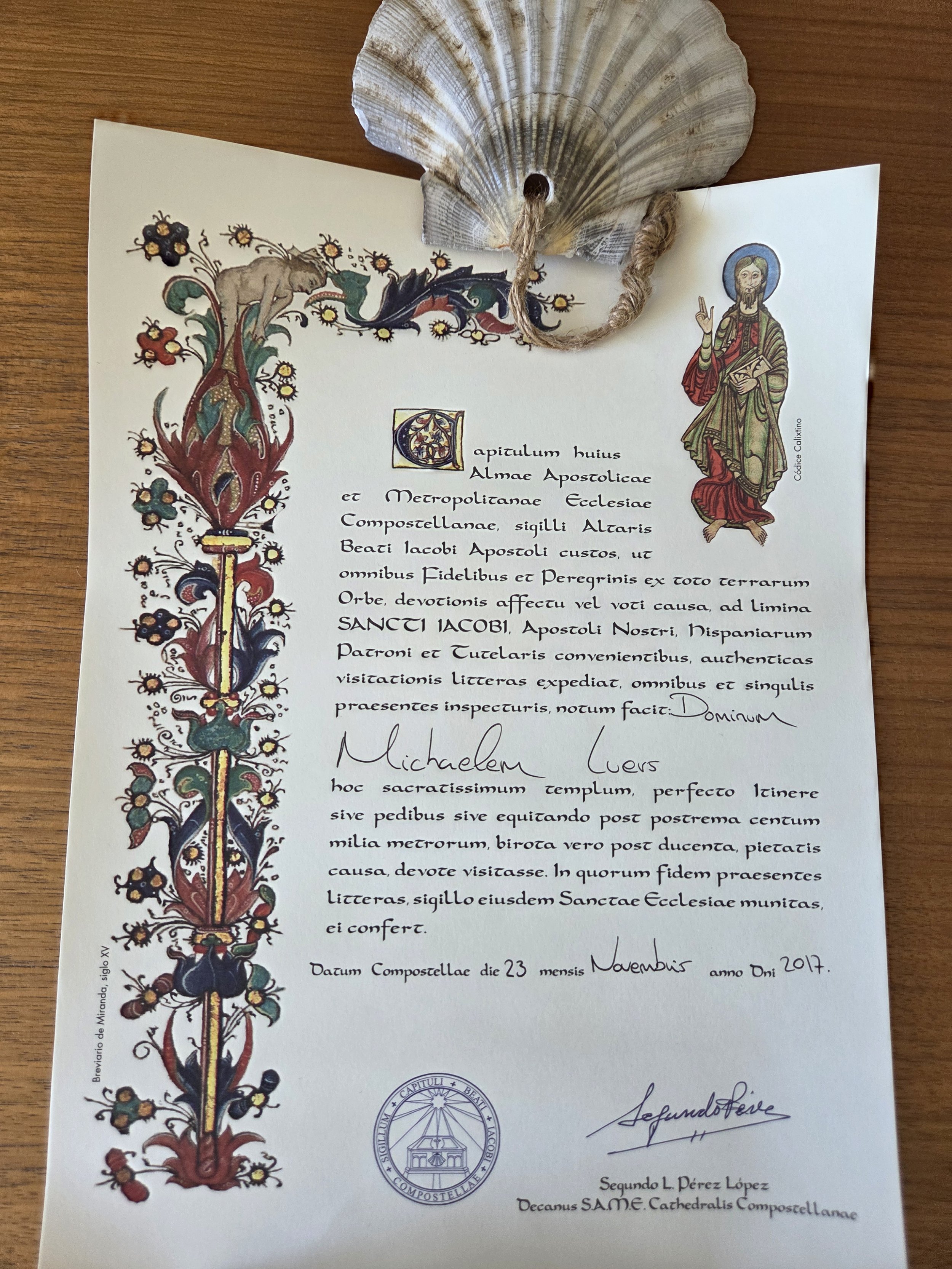
The Compostela is the certificate you receive at the end, presented in Santiago after your credencial is checked. It is written in formal Latin, hand-signed, and traces its lineage back to medieval “cartas probatorias” — evidentiary letters the Church introduced in the 13th century after pilgrims began counterfeiting proof of their journey. Ours reads, in part, that the bearer walked the final hundred thousand metres — post postrema centum milia metrorum — in an attitude of devotion. It is dated and signed by the Cathedral's Dean.
To receive one, you need to have walked at least 100 continuous kilometres on a recognised route, ending in Santiago, with your credencial properly stamped along the way — two stamps a day for the final stretch. As of 2025, the rules loosened slightly: it no longer has to be the literal last 100km into the city, only a continuous 100km stretch on a recognised route that finishes there. You register online before collecting it, receive a QR code, and present your stamped credencial in person at the Pilgrim's Office near the Cathedral. No one can collect it on your behalf — it is yours alone to claim.
Beyond Santiago — the Fisterrana and the Muxiana
Finisterre and Muxía sit beyond Santiago and outside the Compostela's official reach — they are not counted toward the 100km requirement, and they require their own separate certification. If you continue walking to either, you can request a Fisterrana or Muxiana certificate from the town hall once you arrive, using the same credencial you carried from Santiago.
Ours, dated 12 November 2015, is written in Galician rather than Latin — a small but telling difference. Where the Compostela speaks in the formal, churchly Latin of the Cathedral, the Fisterrana speaks in the language of the coast itself: O Concello de Fisterra acredita que … chegou a estas terras da Costa da Morte e fin do Camiño Xacobeo. The Council of Fisterra certifies that you arrived at the Coast of Death and the end of the Way. The illustration at the bottom — the sun setting behind the headland over open water — is almost exactly what you see standing at the lighthouse itself.
The shell
Before our first Camino in 2011, we ordered scallop shells and tied them to our packs the way pilgrims have for centuries — the scallop has marked the Way of St. James since long before stamps and certificates existed, back when the shell itself, collected at the Galician coast, was the only proof a pilgrim could offer that they had truly made the journey.
We have carried the same shells on every Camino since. Fifteen years, five routes, one piece of cord slowly fraying at the edges. It has done more walking than most pilgrims ever will, and we have never once thought about replacing it.
Why it ends up mattering
None of these documents are required to have a meaningful Camino. You do not need a Compostela to know what the walk gave you. But there is something about the small, official weight of them — the Latin, the wax-style seals, the hand signatures, the stamps collected one bar and one church at a time — that turns an experience into an artifact. Something you can hold. Something that, fifteen years later, still sits in a drawer and still means exactly what it meant the day you carried it across the finish line.