A man is beheaded in Jerusalem. His body crosses the sea in a stone boat with no sail and no oar, guided by angels, and comes ashore on the coast of Galicia. It is buried in a field and forgotten for eight hundred years.
That is where the story of the Camino begins — not on a trail, but in a legend. Understanding how that legend became one of the great walking pilgrimages in human history means understanding what actually happened next, as best the historical record can tell it.
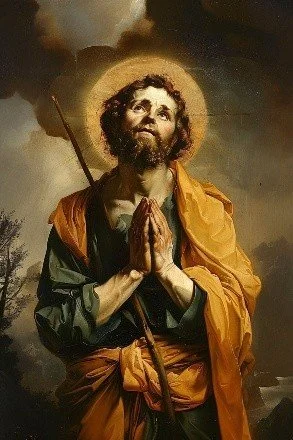
Saint James
The Man
The apostle at the center of the story is James, son of Zebedee, brother of John, one of the twelve, Christian tradition holds that after the crucifixion he preached in Iberia for several years before returning to Judea, where he was beheaded around 44 AD — the first of the apostles to be martyred. Two of his disciples, according to the legend, carried his body back to the northwest corner of Spain by boat and buried him near what is now the town of Padrón, on the Portuguese Camino. Then the story goes quiet. For eight centuries, nothing.
The Shell
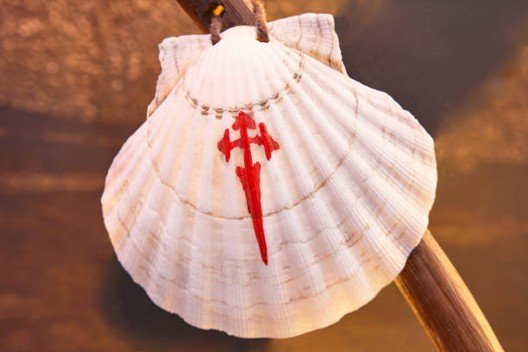
That boat crossing is also where the Camino's most recognizable symbol comes from — and it belongs here, in the first century, not later with the tomb's discovery. Legend holds that as the vessel carrying James's body approached the Galician coast, a knight on horseback (a bridegroom, in some versions, thrown from his mount during a wedding on the shore) was swept into the sea. He was pulled out alive and unharmed, his body and his horse covered head to toe in scallop shells — taken as a sign of the apostle's power before anyone even knew there was a tomb to find. A second version skips the knight entirely: the boat itself is wrecked in a storm, and James's body washes ashore later, undamaged, blanketed in the same shells.
Whichever version a given town tells, the shell attached itself to St. James centuries before Pelayo ever saw a light in the forest (see more below). It had practical uses too — pilgrims carried a real scallop shell as a scoop for water and a bowl to beg with, and merchants around the cathedral later sold them as the era's souvenir, which helped the symbol spread as much as any miracle did. Its shape did the rest of the work on its own: a single point with lines radiating outward, exactly like the many Camino routes across Europe, all converging on one city. It is, along with the yellow arrow you'll meet later in this story, still the one you'll find on your own pack the day you start walking.
The Discovery
The silence breaks around 813–820 AD, in the reign of a Christian king who badly needed some good news.
Spain at that point was almost entirely under Muslim rule. The Christian kingdoms that remained were pushed into a narrow, mountainous strip along the northern coast — Asturias chief among them, ruled from Oviedo by Alfonso II, called “the Chaste.” It was in this cornered, surviving sliver of Christian Spain that a hermit named Pelayo reported strange lights flickering in a forest near the Galician coast. Bishop Theodomiro of the nearby diocese of Iria Flavia went to investigate and found a marble tomb holding three bodies. He declared them to be the remains of St. James and two of his followers.
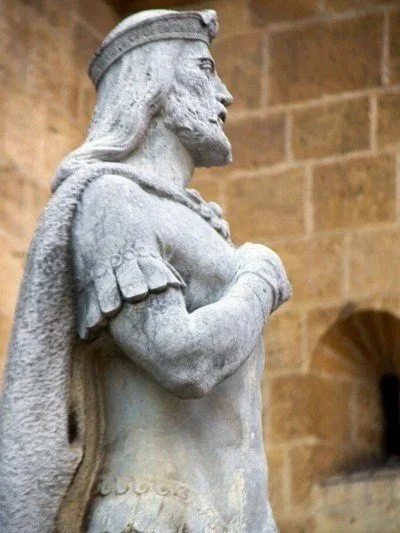
King Alfonso II
Word reached Alfonso II in Oviedo. He traveled to the site to see it for himself — becoming, by tradition, the first pilgrim to Santiago — and ordered a small church built over the tomb. That route from Oviedo, the very first one walked, is known today as the Camino Primitivo, the Original Way.
The site took its name from the discovery itself: Campus Stellae, field of the star, which over centuries softened into Compostela.
A Very Convenient Miracle
It's worth naming the obvious: the timing could not have served Asturias better. A kingdom fighting for its survival on the edge of a vast Muslim caliphate suddenly had an apostle's tomb on its own soil — a direct line to heaven, and a rallying symbol no army could offer. Within a generation or two, the cult of Santiago had hardened into something more martial: the legend of Santiago Matamoros, the Moor-slayer, said to have appeared on a white horse at the Battle of Clavijo in 844 to turn the tide for Christian forces. Most historians today treat Clavijo as legend rather than history, and the warrior-saint imagery as a later invention built to serve the centuries-long Reconquista — the long Christian campaign to reclaim the peninsula.
None of that makes the discovery itself a fraud, or the pilgrimage that followed any less real. It simply means the Camino was political from its very first mile, not only spiritual. That's a thread worth pulling on its own — and we will, in the next piece in this series.
One of the Three Great Pilgrimages
Whatever combination of faith and fortunate timing built it, the pilgrimage to Santiago grew into one of medieval Christendom's three great journeys, alongside Rome and Jerusalem — and the most practical of the three for anyone north of the Pyrenees or Alps. Kings, monks, and commoners walked it. The wealthy sometimes paid a proxy to walk in their place, a practice as old as the pilgrimage business itself, and some simply paid a fee to be excused from a court-ordered pilgrimage altogether rather than walk it themselves.
Courts, for their part, leaned on the Camino constantly. Pilgrimage was rarely a way to shave time off some other sentence — it typically was the sentence, imposed instead of prison, torture, or even execution for lesser crimes. The distance and destination scaled with the offense: a minor theft might mean a short walk to a regional shrine, while a killing of a bishop could mean Rome, Jerusalem, and Santiago all three, on foot, in sequence. Offenders were sometimes made to wear a mark of their crime on the road itself — a murderer might walk in irons forged from his own weapon, wearing them until, town by town, the metal wore away.
What a genuinely pious pilgrim received on completion was a spiritual transaction the Church made increasingly formal as the centuries went on. By 1122, Pope Calixtus II had granted Compostela the right to offer a plenary indulgence — full forgiveness of all accumulated temporal punishment, the time a soul would otherwise spend in purgatory — to pilgrims who visited during a Jacobean Holy Year, any year St. James's feast day (July 25th) falls on a Sunday. Collecting it took more than showing up: confession, communion, a prayer for the Pope's intentions, and passage through the cathedral's Holy Door, opened only in Holy Years (and still done today). Outside those years, smaller indulgences were still on offer at Easter and on James's other feast days. It was, in effect, the medieval Church's most valuable reward, and it did as much as any legend to keep pilgrims walking through the centuries that followed. By the twelfth century the route was well-traveled enough to need a guidebook.
Codex Calixtinus
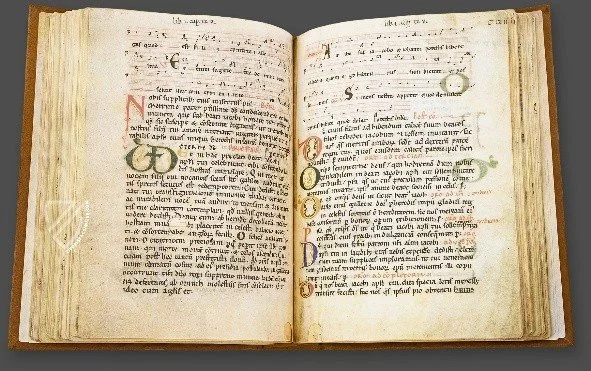
That guidebook survives. Known today as the Codex Calixtinus, it was compiled sometime in the 1130s–1140s, most likely by a French cleric named Aymeric Picaud, and packaged with sermons, accounts of miracles, and a genuinely useful section on the route itself — which rivers were safe to drink from, which towns to avoid, what to expect at each stage. Its introduction carries a letter attributed to Pope Callixtus II, which is how it got its name — except Callixtus had already been dead for over a decade by the time the book was written. The attribution was a flourish added to lend the work more authority, not a record of who actually wrote it. Call it, if you like, the first Camino guidebook, written by someone other than the person whose name is on the cover — which may be the most on-brand detail in this entire history.
The Long Fade
No pilgrimage keeps growing forever. The Reformation cut off much of northern Europe's Catholic pilgrim traffic in the sixteenth century. War, plague, and the general instability of the following centuries thinned the route further. By the mid twentieth century, after two European wars and Spain's own brutal Civil War, long stretches of the Camino Francés had simply grown over — reclaimed by forest and disuse in the empty country of Castile and León. Santiago de Compostela, once one of the most visited cities in Christendom, had settled into being a quiet regional capital that most of the world had stopped thinking about.
Franco's Camino
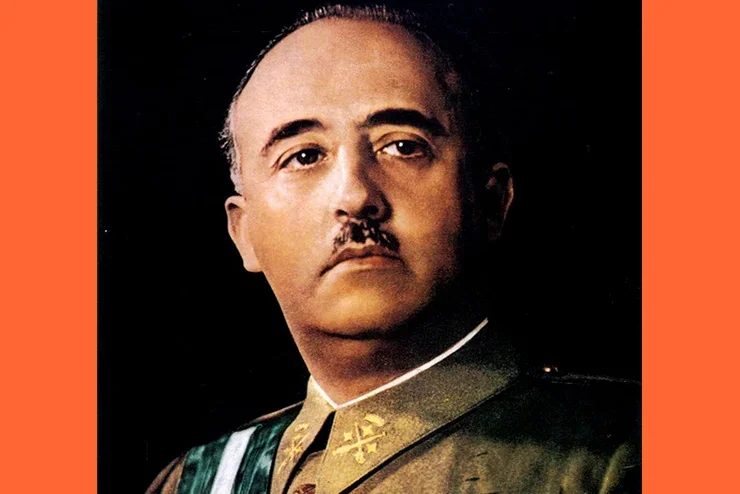
General Franco
The revival, when it came, arrived from an unlikely and uncomfortable direction. Francisco Franco, ruling Spain as dictator from 1939 to 1975, saw in Santiago exactly what Alfonso II had seen eleven centuries earlier: a Catholic, nationalist symbol worth investing in. Franco's government reinstated the historic Voto de Santiago, publicly exalted the saint as a symbol of Spain's traditional and “crusading” character, and folded the Camino into the machinery of state. In 1962 the route was declared a national monument; the following year it was absorbed into the national tourism authority. The regime restored landmark buildings along the way — including the Hostal de los Reyes Católicos in Santiago and the Monasterio de San Marcos in León — as government-run hotels (the Paradores), and marked the route with highway signage aimed at motorized pilgrims and history tourists as much as walkers. During the 1954 Holy Year, Franco himself publicly praised the pilgrimage as living proof of that same crusading spirit, and visitor numbers ticked modestly upward as a result.
It is a complicated inheritance. The same instinct that once turned a hermit's discovery into a kingdom's rallying cry was, a thousand years later, turning a fading regional pilgrimage into a tool of a dictatorship's cultural politics. But whatever the motive, the practical effect was real: after centuries of quiet decline, the Camino had a government-funded pulse again — buildings restored, a route re-marked, a name back in circulation. It was not yet the Camino pilgrims recognize today. That took two more decades, and a very different kind of champion.
The Modern Revival
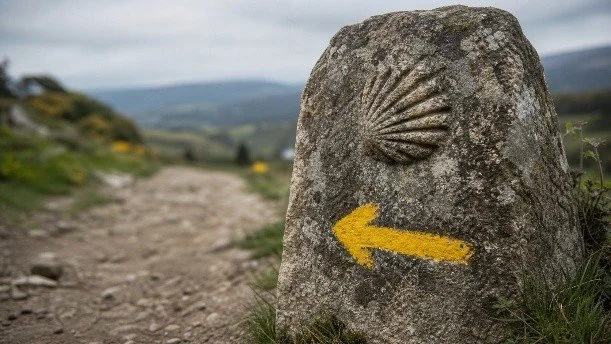
The Camino most of today's pilgrims actually walk — waymarked, hosteled, and internationally known — is largely the work of the 1980s and the momentum that built toward the 1993 Holy Year. A parish priest named Elías Valiña Sampedro, who had spent years researching and defending the route, began painting yellow arrows along the Camino Francés in the late 1970s and early '80s — a simple, stubborn act of marking the way that still guides every pilgrim walking the route today. Spain's post-Franco democratic government, and later the Council of Europe and UNESCO, took up the route as a symbol not of any one nation's politics but of a shared European heritage, naming it Europe's first Cultural Route in 1987 and inscribing it as a UNESCO World Heritage site in 1993.
That Holy Year is generally treated as the turning point. Pilgrim numbers, which had been a few hundred a year for most of the twentieth century, began climbing toward the hundreds of thousands the Camino sees today. Valiña's yellow paint and the shell that was already thirteen centuries old by then are, between them, still the only two things you actually need to find your way to Santiago.
What's Left
Twelve hundred years, one contested miracle, a Reformation, two world wars, a dictatorship, and a parish priest with a paintbrush — that's the honest chain of events that put a scallop shell on your backpack and a yellow arrow on the wall in front of you.
None of it is as clean as the hermit and the field of stars. All of it is true. And somehow the walk still does exactly what it always did.