The Mile Marker was Gone
The photograph below was taken in November 2012, somewhere on the trail between Nájera and Santo Domingo de la Calzada. Two men in their early fifties, sunglasses, blue jackets, grinning into a selfie. Behind them: a new wooden post, clean and elegant, bearing a blue tile with a scallop shell and a yellow tile reading 576 Kms. Five hundred and seventy-six kilometres to Santiago. We were in the middle of our second year on the Camino Francés. The markers had just been installed in La Rioja — fresh wood, unblemished tiles, a new infrastructure for an ancient route.
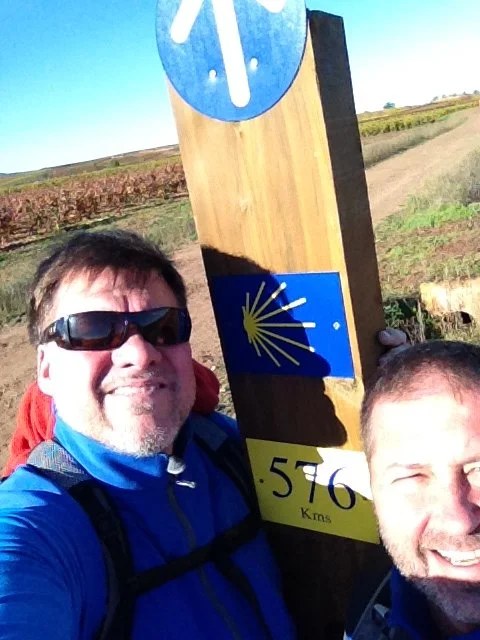
Nov 2012
We had forgotten that morning, to take our daily selfie in front of the hotel before setting out. By the time we remembered, Jim was already ahead of us on the trail, out of reach. We needed something to stand next to. The marker was there. We used it instead. That is why we are grinning — the joy of the Camino on a beautiful November morning, and the mild comedy of substituting a kilometre post for a missing friend.
We went back in November 2022. Same stages, same month, ten years later. Jim couldn’t come — a temporary medical issue, but that year it was the two of us. We were looking for the same road we had walked in 2012. In some ways we found it.
In some ways we found something else.
What was there, and what wasn’t
The marker was gone. Not damaged, not graffitied, not pushed over. Gone. The plinth remained — the concrete base that had held the post — but the post itself had been removed or had fallen or had been taken.
In its place: nothing. The trail continued. The vineyards were there. The light was the same low November light it had always been. But the marker we had photographed ten years earlier was absent.
We stood there for a moment. Mike took a photograph anyway — two men in their early sixties, ten years older, standing in the same spot in front of nothing.
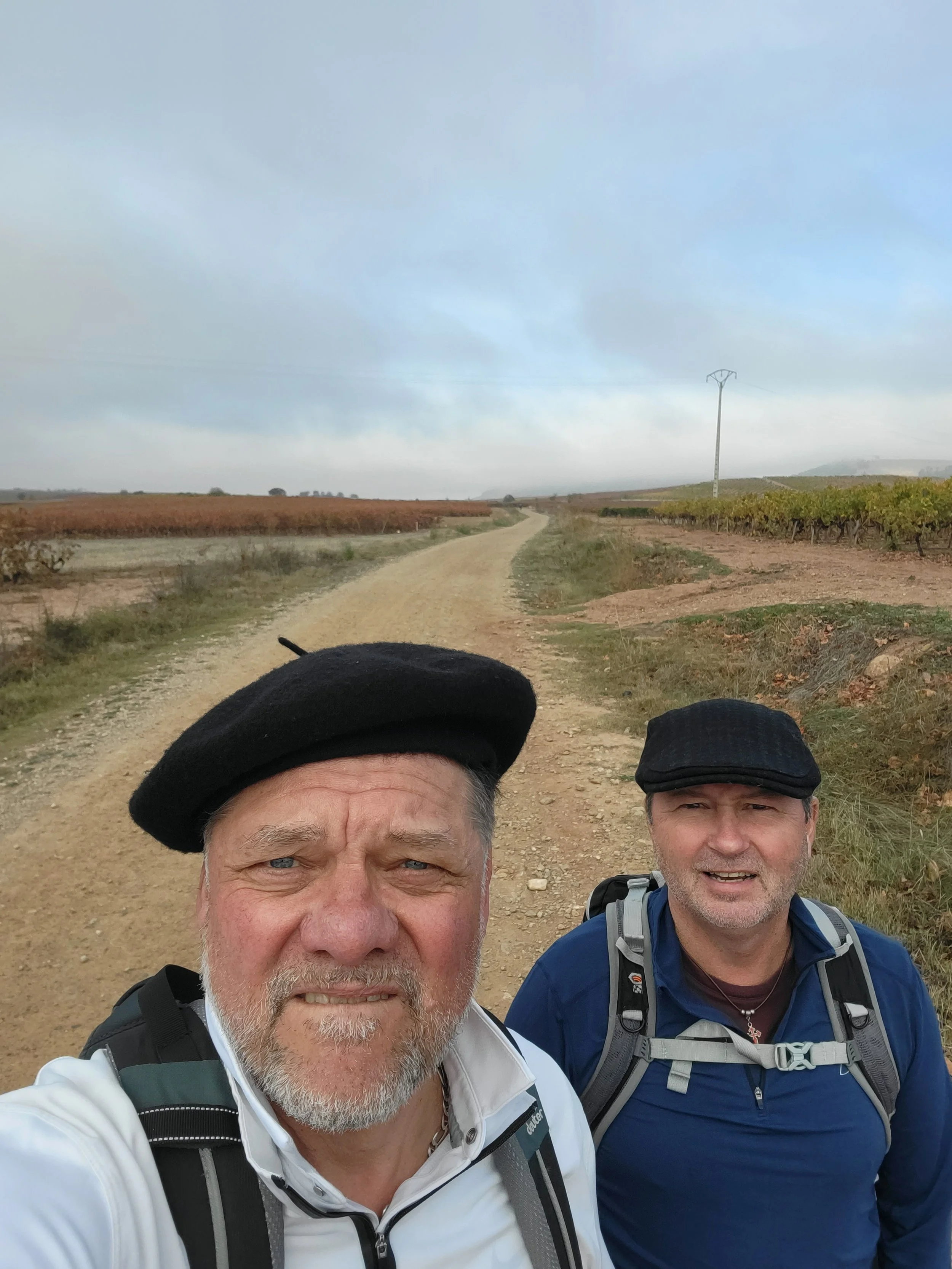
Nov 2022
It wasn’t just that marker. Along the whole route — Pamplona to Burgos, the same stages we had walked in 2012 — the markers told the same story. Tiles missing from markers here and there. The Camino-branded ceramic tiles, with their scallop shells and distances, taken as souvenirs or simply vandalised. Graffiti on the wooden posts. The elegant new infrastructure of 2012 showing ten years of human attention, not all of it respectful.
The Camino Francés carried roughly 40,000 pilgrims a year when we first walked it in 2011. By 2022 that number had more than tripled. The markers were installed for one Camino. They were used by another.
"Disappointment. Sadness, that pilgrims would desecrate the markers. But not surprise. Maybe a little feeling of aging, getting old, noticing change."
What ten years does to two men
We had not walked together since November 2019 — the pandemic took 2020 and 2021, and by the time it was over we were eager and overdue. Jim’s medical issue meant he couldn’t join us, which was its own absence. We had done this route originally as three. We were doing it again as two, on the tenth anniversary of the first time, without the third man.
That absence ran underneath the whole walk. Jim was healthy again by the following year — he started the Via de la Plata with us in 2023 — but in November 2022 it was Mike and Paul on a route that had been the three of us, in a year when both of us were carrying things from the decade that had passed. The walk was what the walk has always been for people arriving with weight: useful. Necessary, even.
The Camino has never asked what you are carrying. It simply provides the space to carry it differently for a while.
"It was fun but also more introspective and, with the reminiscing and absence of Jim, a slight melancholy feeling of time and aging.
What the road still gave us
Here is what is true and important: the Camino between Pamplona and Burgos in November 2022 was still, in all the ways that matter, the Camino between Pamplona and Burgos. The walking was the same. The rhythm of early starts and long days, the aches and pains and the satisfaction of arriving somewhere on foot was unchanged. The towns — Puente la Reina, Estella, Los Arcos, Logroño, Nájera, Santo Domingo, Belorado — were the same towns, some of them better than we remembered.
Pamplona in the main square was wonderful and the same. Estella revealed itself again as a forgotten gem — a town that most pilgrims pass through too quickly and that rewards the ones who stop. Nájera: Rioja wine by the church in the plaza in the late afternoon. These moments were intact.
Belorado was quiet and empty, as it had been in 2012. We taxied from the town to a Casa Rural outside it and were met by the elderly owner — an abuela, as it turned out, who did not speak English. Her daughter, who did, arrived later with her young daughter, the three generations together to help prepare our dinner. It was warm and unhurried and almost familial — the kind of evening that only happens when the house opens itself to you.
And Logroño on a Friday night in 2022 was better than we remembered from 2012. The tapas street — the Calle Laurel — was extraordinary in a way we had not fully understood the first time. Small plates, cold wine, the whole city out and talking. We finally understood why Logroño claims to be the best tapas town in Spain. They may be right.
In Puente la Reina we stopped at the Hotel Abideán for a drink — we had stayed there in 2012 and wanted to return to it. A couple from New York were sitting at the same table where we had sat for post-walk drinks ten years earlier. We did not tell them that. We simply sat nearby and, in the way of the Camino, began talking. We walked with them on and off over the next three or four days. The last time we saw them was on a sunny afternoon, all four of us sharing a chocolate bar on the trail. They were stopping in Navarrete. We continued to Nájera. That exchange — the same table, different strangers, the same feeling — was exactly 2012.
There are always characters on the Way. We were staying at a Casa Rural outside Los Arcos. Paul and I arrived first and spent the afternoon sharing a bottle of wine on the patio in the autumn sun. A couple of Irish women arrived by taxi later — two women in their mid-fifties, warm enough company. We ate dinner at separate tables, the same meal, served by the proprietor. One of them had spent most of the day’s walk (and the next) on FaceTime, speaker phone at full volume. She put it away for dinner, which was a relief. The road produces these people in every year, in every season. They are part of it.
"The pilgrim spirit was unchanged."
The thing about returning
Here is the difference that surprised us most, and that we had not anticipated. Every other Camino we have walked was new. The Inglés, the Coastal, Finisterre and Muxia, the Via de la Plata — unknown territory, every stage a discovery. The Francés in 2012 was the same. We were new to it and it was new to us.
Walking the Pamplona to Burgos stages again in 2022, we were not new to it. We knew it. We noticed the things we remembered and the differences on the road. We were not embracing the experience of the path in the same way — noticing how sore our feet were, marvelling at the next village — because we already knew what was coming. The knowledge of having been somewhere before is both a gift and a tax on the experience of being there again.
The mile marker was gone. The marker we had photographed in 2012 was not there in 2022. But we were also different men standing in a different decade, and the gap where the marker had been was also, in some way, a measure of the gap between who we were. This does not mean the return was a mistake. The Camino gave us what we needed in 2022 just as it had in 2012. The gifts were different because we were different. That is perhaps the whole point
What the mile markers mean
The Camino Francés is one of the most walked long-distance routes in the world. It was a quiet pilgrimage for centuries — a few thousand people a year making a religious journey across the north of Spain. Then a book was published, and a film was made, and the numbers began to climb, and by the time we first walked it in 2011 it was already changing, and by 2022 it had changed considerably more.
The missing tiles are a symptom. Someone walked past a beautiful marker and decided to take the tile home as a souvenir. Then someone else did. Then someone tagged the post with a marker pen. Then someone else did. None of them, individually, intended to damage the Camino. All of them, collectively, damaged the Camino. This is the familiar story of every beautiful place that becomes popular — the Venice problem, the Machu Picchu problem, the Camino problem.
The question is what you do with this knowledge. The answer is not simple.
The Camino is a wonderful experience that everyone should have. The physical exertion, the pain, the camaraderie, the internal, personal effect of the walking — these are not diminished by the number of people on the road. The pilgrims we met in 2022 were the same pilgrims we had met in 2012. The spirit was unchanged. The tiles were missing but the spirit was intact.
Humans affect their environment. It is what we do. The Camino path is different now from what it was in 2012, and it was different in 2012 from what it was in 1990, and different in 1990 from what it was in medieval times. The pilgrims before us changed it. We changed it. The pilgrims coming after us will change it further. The question is whether what changes and what remains is the right balance. For now, it is
Whether to go back
We were asked whether we would walk the same stages a third time in 2032.
The honest answer is probably not — not because the road is not worth walking again, but because, for me, the full Camino Francés, all the way from Saint-Jean, is a goal that has not yet been walked in a single continuous journey. If there is a return to the Francés, it will be the whole thing. That feels like the right shape for it. Hopefully, with the three of us.
But the question underneath the question is whether to go back at all — whether the road you remember is still there, whether returning to a beloved place can ever equal the first time. The answer, from this experience, is that the right question is the wrong one. You do not go back to find what you left. You go back to find what is there now, which includes who you are now.
The marker was gone. Logroño was better than we remembered. Jim was absent. The New York couple were at our table at the Abideán. The FaceTime woman was there. Paul and I were there, ten years older, carrying different weight, on the same road.
The Camino gave us what we needed. It always does.
“The Camino is timeless. Walk it.”