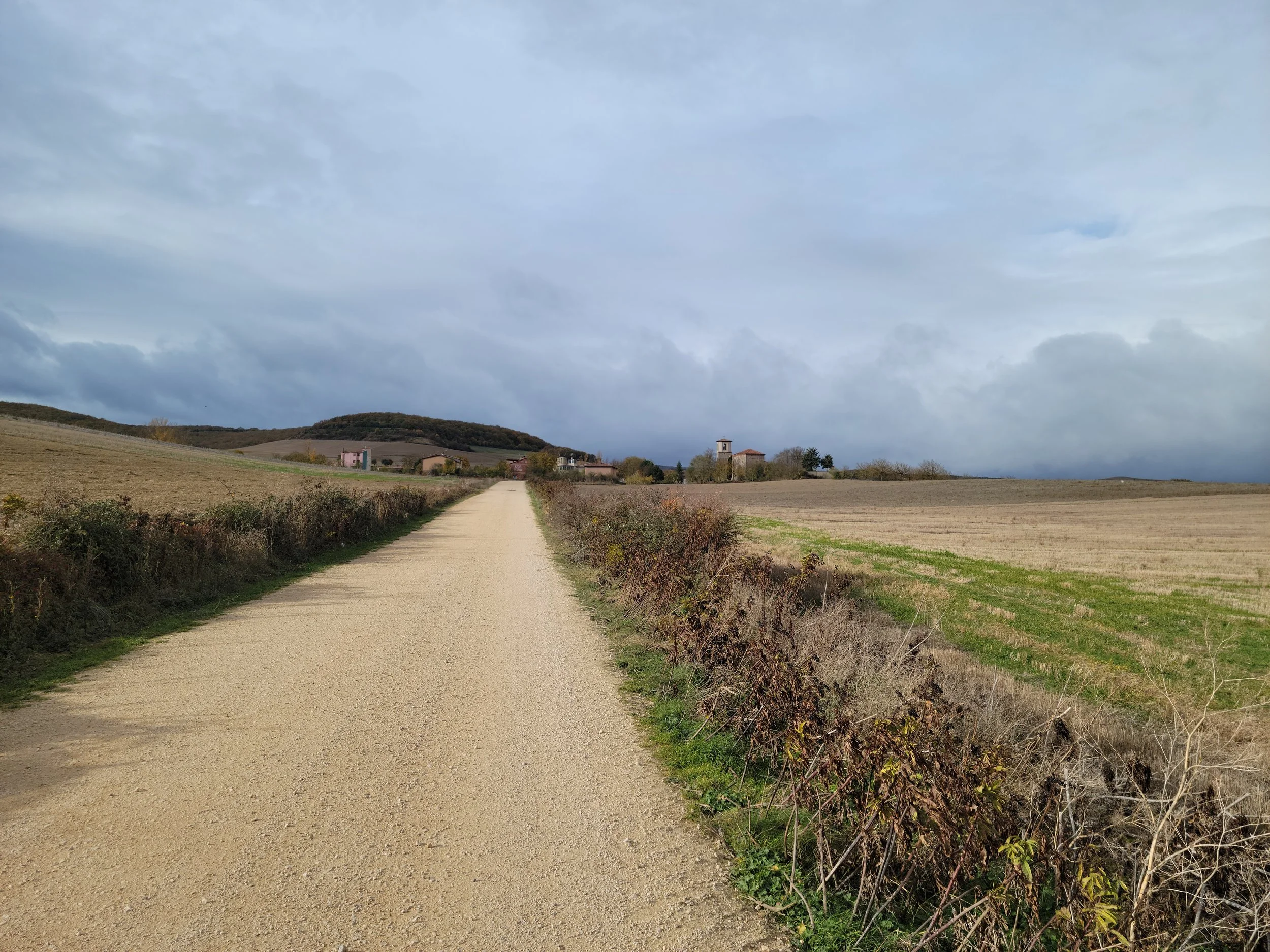
Camino Francés — The French Way
Saint-Jean-Pied-de-Port to Santiago de Compostela
800 kilometres. Seven sections. The road that started everything.
Where most people begin
The Camino Francés is where most people begin — and where many keep returning. It is the oldest continuously walked pilgrimage route in the Western world, the road that carried medieval pilgrims across northern Spain for a thousand years and still carries more than 200,000 walkers every year. If you have heard of the Camino, this is almost certainly the one you heard of.
It begins in the French Basque town of Saint-Jean-Pied-de-Port, at the foot of the Pyrenees, and ends 800 kilometres later in the Plaza del Obradoiro in Santiago de Compostela. Between those two points it crosses a mountain range, descends into the wine country of the Rioja, crosses the long open plateau of the meseta, climbs back into the green hills of Galicia, and delivers you — changed, if you let it — to the cathedral steps.
We have walked every section of this route. It took us five Novembers to do it, one section at a time, fitting the Camino around work and family. By the time we reached Santiago we had earned every step of it — and we understood, in a way we couldn’t have predicted at the start, why people keep coming back.
What this route gives you
The Francés is the most walked route for a reason. The infrastructure is excellent, the pilgrim community is rich and international, and the road itself is extraordinarily varied — no two sections feel the same. The Pyrenees crossing on day one is one of the most dramatic opening stages in walking anywhere in the world. The descent into Navarra is its own world — lush green valleys, Basque villages, the particular quiet of a landscape that has been receiving pilgrims for a thousand years. Then the region changes and the Rioja begins: sun-warmed vineyards, terracotta earth, and extraordinary wine. The meseta, which many pilgrims approach with dread, turns out to be the section where the Camino really deepens its work — the quiet, the rhythm, the unbroken road ahead, the noise in your head finally running out of fuel. And then Galicia appears on the horizon, green and damp and ancient, and you know you are almost there.
Eight hundred kilometres sounds daunting — and walking the whole thing in one go, if you have the time and the motivation (or need), is one of the great physical and personal journeys available to anyone. Walking the Francés in sections over multiple trips is a wonderful and meaningful way to walk your Camino as well. We walked it in sections of eight to ten days at a time, returning each year to pick up where we left off. Each section has its own character, its own rhythm, and its own rewards. Walk one and you will understand why we came back for the next.
Camino Francés — Stages by Section
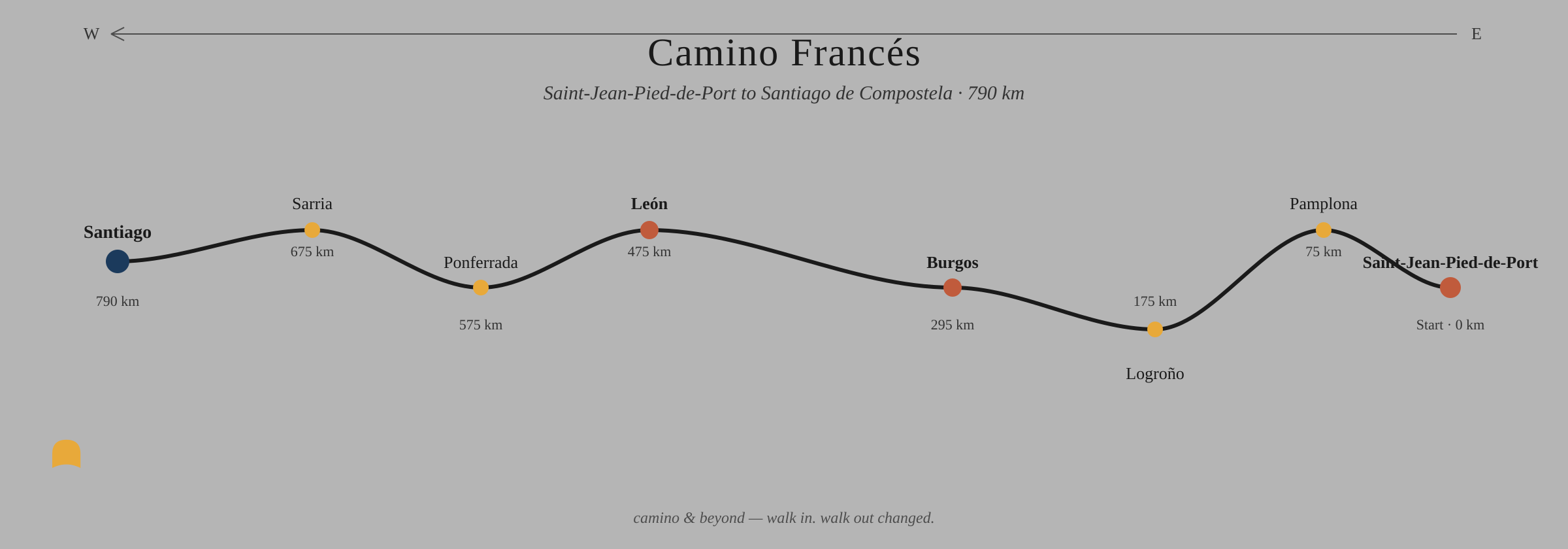
35 stages across seven sections. Walking distances are approximate .
Section 1 — Saint-Jean-Pied-de-Port to Pamplona (~70km)
Stage 1 — Saint-Jean-Pied-de-Port to Roncesvalles — 25km
The Camino begins with one of its most demanding and beautiful days — a steep climb over the Pyrenees on the Napoleon Route, rewarded with sweeping mountain views and a long descent through beech forest into Roncesvalles. An alternative lower route via Valcarlos is available in bad weather. Arrive at the ancient monastery that has sheltered pilgrims since the 12th century.
Stage 2 — Roncesvalles to Zubiri — 22km
A gentler day after the mountains — wooded valleys, small Navarrese villages, and the rhythm of the road beginning to settle. The path follows the Arga river for much of the descent, crossing a medieval bridge into Zubiri.
Stage 3 — Zubiri to Pamplona — 20km
Rolling Basque foothills lead through the charming village of Trinidad de Arre before the medieval walls of Pamplona come into view. Enter the city through the ancient gate and walk to the legendary Plaza del Castillo — your first great plaza on the Camino.
Section 2 — Pamplona to Logroño (~100km)
Stage 4 — Pamplona to Puente la Reina — 24km
A steady climb out of Pamplona to the Alto del Perdón ridge, where a famous line of iron pilgrim silhouettes marks the horizon — one of the most photographed spots on the entire Camino. A long descent through vineyards and wheat fields leads to Puente la Reina and its magnificent Romanesque bridge over the Arga.
Stage 5 — Puente la Reina to Estella — 22km
A rolling stage through the heart of Navarra — Roman roads, olive groves, and the wine fountain at Bodegas Irache where pilgrims fill their bottles free of charge. Estella is one of the most beautiful medieval towns on the route, well worth an evening walk.
Stage 6 — Estella to Los Arcos — 22km
Quiet countryside and ancient churches mark this gentle stage through the Camino’s rural heart. The walking is easy and the road unhurried — the kind of day the meseta will eventually offer in longer form.
Stage 7 — Los Arcos to Logroño — 28km
The longest stage of this section crosses into La Rioja — Spain’s great wine region — and arrives in Logroño, famous for its tapas bars on Calle Laurel. A Friday or Saturday night here is an experience in itself.
Section 3 — Logroño to Burgos (~120km)
Stage 8 — Logroño to Nájera — 29km
Deep into the Rioja — the path winds through vineyards with red and terracotta earth underfoot, the landscape unlike anything before it on the Camino. Nájera sits beside the river Najerilla beneath dramatic red cliffs, with a royal monastery carved into the rock.
Stage 9 — Nájera to Santo Domingo de la Calzada — 21km
A pleasant walking day across rolling farmland, arriving in one of the Camino’s most characterful towns. The cathedral here houses a live cockerel and hen — part of a medieval miracle story every pilgrim eventually hears.
Stage 10 — Santo Domingo de la Calzada to Belorado — 23km
Crossing from La Rioja into Castile, the landscape opens and the road stretches ahead with a new sense of space. Belorado is a lively market town with good pilgrim infrastructure.
Stage 11 — Belorado to Atapuerca — 30km
One of the more demanding stages of this section — a climb through the oak and pine forests of the Montes de Oca, passing the ancient monastery of San Juan de Ortega before arriving in Atapuerca, a small village whose prehistoric caves are a UNESCO World Heritage Site containing some of the oldest human remains in Europe. A rustic overnight here — wood stove, pilgrim meal, genuine quiet — is one of the Camino’s hidden pleasures.
Stage 12 — Atapuerca to Burgos — 23km
A long approach into Burgos through rolling farmland, past an airport and then through the city’s industrial outskirts — the walk earns its reward when the soaring Gothic spires of the cathedral finally come into view. One of the great cities of the Camino, worth at least one full rest day.
Section 4 — Burgos to León — The Meseta (~180km)
Stage 13 — Burgos to Hornillos del Camino — 21km
The meseta begins without fanfare — the path leaves Burgos and the land simply opens, vast and flat and strangely beautiful. Sky dominates. The road stretches ahead with nothing to interrupt it. This is the Camino starting to work on you.
Stage 14 — Hornillos del Camino to Castrojeriz — 20km
The meseta deepens. Wheat fields in every direction, the occasional village, the sound of your own footsteps. Castrojeriz sits dramatically beneath the ruins of a hilltop castle.
Stage 15 — Castrojeriz to Frómista — 25km
A sharp climb over the Mostelares plateau rewards with sweeping views before a long descent to the Canal de Castilla and the flat walking into Frómista, home to one of the finest Romanesque churches in Spain.
Stage 16 — Frómista to Carrión de los Condes — 19km
Canal paths and cereal fields — the meseta at its most meditative. The road asks very little of your body and everything of your mind. Carrión de los Condes is a pleasant medieval town with good accommodation.
Stage 17 — Carrión de los Condes to Terradillos de los Templarios — 27km
The longest single stretch of the meseta without a village — seventeen kilometres of open plateau between Carrión and Calzadilla de la Cuéza with no services. Carry water and food. The silence here is profound. Terradillos takes its name from the Knights Templar, who once held these lands.
Stage 18 — Terradillos de los Templarios to Sahágún — 13km
A short, easy stage to Sahágún — historically significant as the midpoint of the Camino and once home to the most powerful monastery in medieval Spain. The meseta begins its slow, almost imperceptible release.
Stage 19 — Sahágún to Mansilla de las Mulas — 37km
A long day marking the meseta’s gradual end — the landscape softens, the road quietens, and the promise of León begins to take shape on the horizon. Can be split at Burgo Ranero (17km) for a more comfortable two-day approach.
Stage 20 — Mansilla de las Mulas to León — 18km
The final approach to León through the city’s quiet outskirts, arriving at one of the great cities of northern Spain. The cathedral’s stained glass — 1,800 square metres of it — is among the finest in the world.
Section 5 — León to Ponferrada (~100km)
Stage 21 — León to Villavente — 12km
A gentle first day out of León — flat walking through the páramo, the high plateau west of the city, easing back into the road’s rhythm after the city.
Stage 22 — Villavente to Astorga — 33km
A long day across the páramo to Astorga — a Roman city with a Gaudí-designed bishop’s palace, an extraordinary cathedral, and some of the best chocolate in Spain. Worth arriving early enough to explore.
Stage 23 — Astorga to Rabanal del Camino — 21km
The mountains return — a gradual but steady climb through the foothills of the Montes de León, the landscape becoming wilder and more dramatic with each kilometre. Rabanal is a quiet, atmospheric village at the foot of the high pass.
Stage 24 — Rabanal del Camino to Molinaseca — 25km
One of the most memorable days on the entire Camino — a climb to Cruz de Ferro at 1,504 metres, where pilgrims have left stones and the burdens they carried for centuries. Then a long, knee-testing descent through the Bierzo valley to Molinaseca, a beautiful medieval village with a river beach that has welcomed exhausted pilgrims for generations.
Stage 25 — Molinaseca to Ponferrada — 7km
A short and pleasant stage into Ponferrada, dominated by the magnificent 12th-century Templar castle — one of the largest and best-preserved in Spain.
Section 6 — Ponferrada to Sarria (~100km)
Stage 26 — Ponferrada to Villafranca del Bierzo — 24km
The Bierzo wine country — gentler terrain, lush valleys, and a landscape that feels like a deliberate kindness after the mountains. Villafranca del Bierzo is one of the most beautiful towns on the Camino, with its own Puerta del Perdón for pilgrims too ill to continue.
Stage 27 — Villafranca del Bierzo to O Cebreiro — 29km
The hardest climb on the Camino — a relentless ascent of nearly 900 metres from the valley floor to O Cebreiro at 1,300 metres, often in mist or cloud. The reward at the top is Galicia — an entirely different world from everything that came before it.
Stage 28 — O Cebreiro to Triacastela — 21km
The first day in Galicia — the landscape is green, intimate, and ancient, the path winding through stone villages and eucalyptus forests. A mostly downhill stage after yesterday’s climb, with the particular green light of the northwest settling in around you.
Stage 29 — Triacastela to Sarria — 19km
Two route options — via Samos, with its ancient monastery, or the more direct path via Calvor. Both arrive in Sarria, the gateway to the final 100km and the most common starting point for pilgrims walking just the minimum for the Compostela.
Section 7 — Sarria to Santiago (~115km)
Stage 30 — Sarria to Portomarín — 22km
The final 100km begins — the road fills with new pilgrims and the energy of the Camino shifts. Portomarín sits above a reservoir, its Romanesque church relocated stone by stone when the valley was flooded in the 1960s.
Stage 31 — Portomarín to Palas de Rei — 25km
Rolling Galician hills on the corredoiras — ancient stone lanes worn smooth by centuries of pilgrims — with the steady, gathering sense that Santiago is real and getting closer.
Stage 32 — Palas de Rei to Melide — 15km
A welcome shorter day through quiet countryside, arriving in Melide — famous throughout Galicia for its pulpo (octopus), served in the market square with rough local wine. Do not miss it.
Stage 33 — Melide to Arzúa — 14km
Deep Galician countryside at its most intimate — small farms, ancient stone walls, the smell of eucalyptus. A quiet stage before the final push.
Stage 34 — Arzúa to O Pedrouzo — 20km
The penultimate day — the anticipation is almost physical now. The road carries you forward whether you feel ready or not.
Stage 35 — O Pedrouzo to Santiago de Compostela — 20km
The last day. A final climb to Monte do Gozo — the Hill of Joy — where pilgrims have caught their first glimpse of the cathedral towers for a thousand years. Then the descent through the city, the narrow streets, the sound of the bagpipes, and the square opening before you.